

If you live in Kingston, you have probably done the “grab a case of water” habit at least once, especially when the tap smells like chlorine in winter or your kettle keeps scaling up. The question I hear most in neighbourhoods like Bayridge, Williamsville, and Collins Bay is not “Is RO good?” It is: “Is RO actually cheaper than bottled water?”
This guide breaks down the real costs (not just the sticker price) so you can decide what makes sense for your household in 2026.
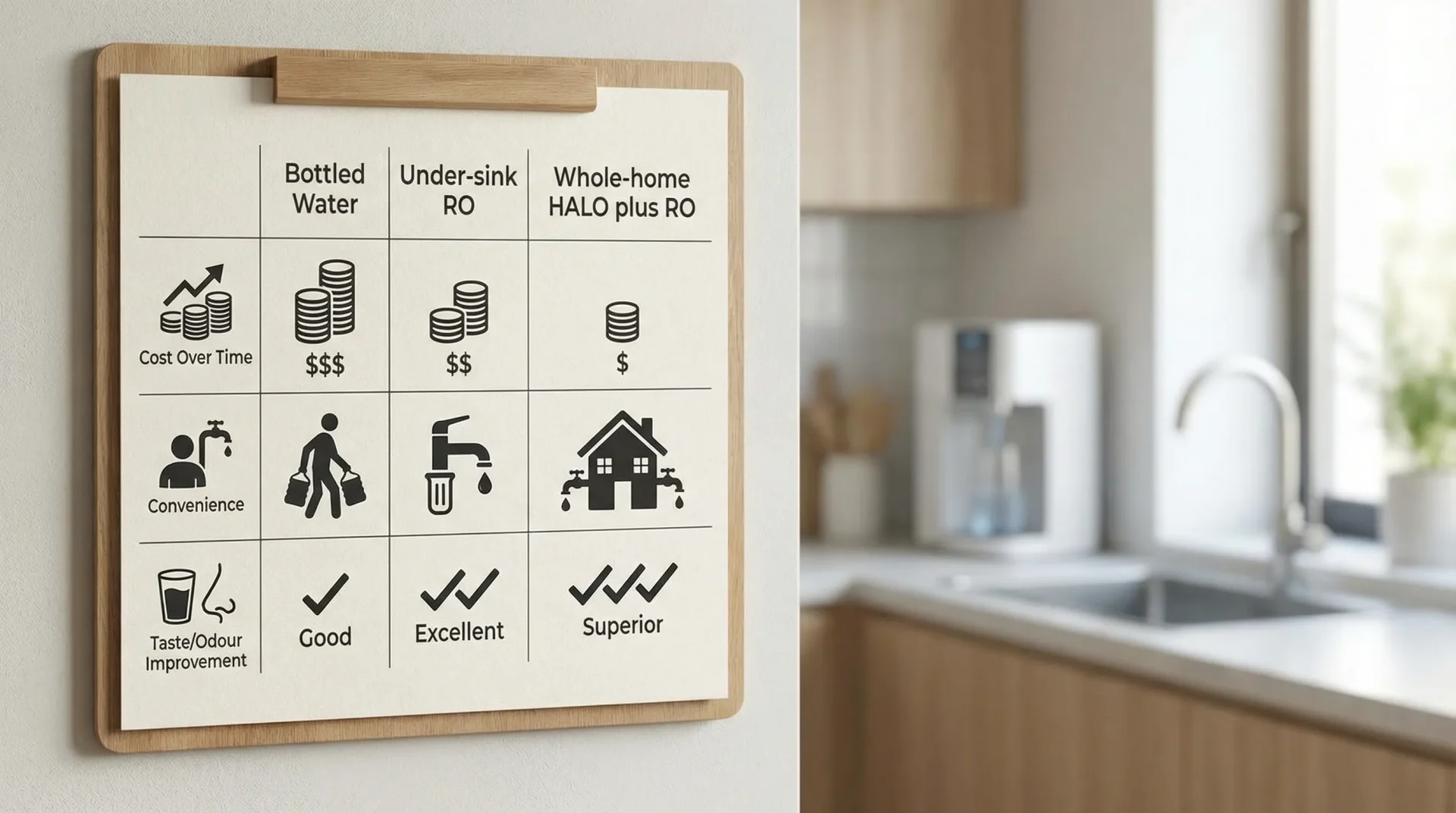
Quick answer: RO usually wins on cost (and convenience)
For most Kingston homeowners who buy bottled water weekly, an under-sink reverse osmosis (RO) system tends to cost less over a few years, especially for families.
Where homeowners get surprised is that bottled water costs are not just dollars per case. They include:
- How many litres your household actually drinks (water, coffee, ice, pets)
- How you buy it (single bottles vs. large jugs)
- Driving and impulse top-ups
- Storage space and recycling return trips
And on the RO side, the “hidden” costs are mostly predictable (filter changes and occasional membrane replacement).

Start with Kingston reality: the tap is safe, but taste and scale are common complaints
Kingston’s municipal water is treated and monitored to meet regulatory requirements. If you want to see what is being tested and reported, start with:
- Utilities Kingston water quality information
- Health Canada’s Guidelines for Canadian Drinking Water Quality
So why do people still buy bottles?
- Chlorine taste and odour (often more noticeable in winter when homes are sealed up)
- Hard water scale (Kingston is the Limestone City for a reason)
- Preference for “crisp” tasting water for coffee, tea, and ice
For city water homes, TapTech typically prioritizes HALO Water Systems to improve taste and help with scale protection at every tap, and then adds RO where you drink water most.
Related reading: Kingston tap water chlorine: why you smell it in winter and Halo vs Brita: best fix for chlorine taste in Kingston.
What bottled water really costs in Kingston (3 common buying patterns)
Bottled water costs vary wildly depending on what you buy. Here are the patterns we see most often.
Pattern A: Cases of small bottles (most expensive per litre)
This is the “convenience first” option. It is usually the highest cost per litre and creates the most packaging.
Good for:
- Short-term events
- Emergency supply
- Kids sports bags
Not great for:
- Daily home drinking water
Pattern B: Large jugs with a dispenser (mid-cost per litre)
Many households switch to 18.9 L jugs. The cost per litre is often lower than small bottles, but you still have recurring purchases and logistics.
Also consider:
- Jug deposits and returns
- Dispenser purchase (or rental from some suppliers)
- Lifting and storage
Pattern C: “Top-up” bottled water (the sneaky budget killer)
This is the pattern that quietly makes bottled water expensive:
- You buy a case “just in case”
- You run out mid-week and buy another
- You add a few cold bottles at checkout
It is common in busy households in Cataraqui North or Portsmouth Village where schedules are packed and nobody is tracking the actual monthly spend.
What RO really costs (and what you need to maintain)
An under-sink RO system is mostly a one-time investment plus consumables.
Typical cost categories include:
- Equipment and installation (varies by system and plumbing setup)
- Pre-filters / carbon filters (usually annual, depending on water usage and water quality)
- RO membrane (often replaced every few years, depending on feed water and maintenance)
- Optional: remineralization if you prefer a less “flat” taste
Two Kingston-specific notes:
- If your main complaint is chlorine taste, many homeowners get the best experience with whole-home carbon filtration (HALO) plus RO at the kitchen sink. The HALO helps protect fixtures and improves shower and laundry water, RO is for the drinking tap.
- RO is a polishing step. If your water has major issues (common on rural wells), you typically want the right pre-treatment first.
Related reading: Water softener vs filter vs RO vs UV: what Kingston homeowners should know and Water testing at home vs pro testing: what’s accurate?.
A real cost comparison you can customize (1 year, 5 year, 10 year)
Instead of pretending there is one perfect number, use a simple model:
- Litres per day your household drinks (include coffee, tea, ice)
- Cost per litre of your bottled option
- Compare to RO’s upfront + maintenance
Step 1: Estimate how many litres you actually use
A practical range for drinking and cooking water is often 1 to 3 litres per person per day, depending on habits.
A quick household estimate:
- Single adult: 2 L/day
- Couple: 4 L/day
- Family of 4: 8 L/day
Step 2: Plug into a simple comparison table
The table below uses example pricing ranges because bottled prices and RO installation details vary by retailer, system, and home. The point is the scale of the difference over time.
| Household | Drinking water used | Bottled water spend (example range) | Under-sink RO total cost (example range) | What usually happens in real life |
|---|---|---|---|---|
| 1 adult | ~2 L/day (730 L/year) | Higher if buying small bottles, lower with jugs | Upfront cost is noticeable, then predictable maintenance | RO often breaks even in a few years if bottled is weekly |
| 2 adults | ~4 L/day (1,460 L/year) | Recurring cost adds up quickly | Maintenance is similar, usage increases do not “double” costs | RO tends to win sooner |
| Family of 4 | ~8 L/day (2,920 L/year) | Often a major line item by year 2 to 3 | RO becomes very cost-effective if you stop buying cases | RO typically wins clearly on cost and convenience |
What this table is not doing (on purpose): quoting a “TapTech price.” Every home’s plumbing access, drilling needs for the faucet, and water conditions can change the installed cost.
If you want a deeper dive on the broader pros and cons (not just cost), you can also read: Is bottled water really better than treated tap in Kingston?.
The costs most homeowners forget to count
If you are trying to be honest about the comparison, these are the “real world” factors:
Bottled water: time, storage, and hassle
Even if you never put a dollar amount on your time, you feel it.
- Carrying cases up stairs (hello, downtown walk-ups)
- Taking empties back for returns
- Losing pantry space
- Running out at the worst time
RO: filter discipline
RO’s downside is simple: you need to keep up with maintenance.
If filters are overdue:
- Taste can drift
- Flow can drop
- The membrane can wear faster
A good installer will set expectations clearly and help you systematize maintenance so it is not a guessing game.
Best setup for most Kingston city-water homes: HALO plus RO
If you are on municipal water in Kingston Proper (West End, Downtown, East End), the most common “best of both worlds” setup is:
- Whole-home filtration and conditioning (HALO) for chlorine taste/odour reduction and scale protection throughout the house
- Under-sink RO for drinking and cooking water
This combination tends to make sense when you want:
- Better showers (less chlorine smell)
- Cleaner fixtures and less spotting
- Better tasting water from one dedicated faucet
To learn more about HALO in particular: Tap Tech partners with Halo Water Systems.
What about Gananoque and Napanee (well water and aggressive water)?
If you are on a private well in areas like Gananoque or Napanee, the comparison shifts.
Many well owners buy bottled water because they are dealing with problems like:
- Iron staining
- Sulphur odours
- Very high hardness
- Low pH (aggressive water)
In those cases, RO can still be a great drinking-water solution, but it often should be paired with the right whole-home treatment first. TapTech typically recommends Novo Water Conditioning for aggressive and well-water conditions because it is built to handle tougher inputs (iron, sulphur, heavy hardness) when properly specified.
If you are unsure what you have, start here: Water testing at home vs pro testing: what’s accurate?.
When bottled water still makes sense
Bottled water is not “wrong.” It is just usually expensive as a long-term daily strategy.
Bottled water can still be the right call if:
- You are renting and cannot install equipment
- You need a short-term solution while you plan upgrades
- You want a small emergency supply on hand
Many homeowners do both: RO for daily life, a small bottled supply for outages and storms.
A simple decision checklist (Kingston edition)
If you are deciding this month, ask yourself:
- Are you buying bottled water weekly (or more)?
- Is your main complaint taste and chlorine odour, especially in winter?
- Do you also want less scale on fixtures, kettles, and glass?
- Are you on city water (HALO is often a great fit), or on a well (Novo is often the better starting point)?
If you answered “yes” to the first two, RO is usually worth pricing out.
Frequently Asked Questions
Is RO water cheaper than bottled water in Kingston? For many households, yes, especially if you buy bottled water weekly. RO has upfront costs, but bottled water is a recurring purchase that often exceeds RO over a few years.
Does RO remove chlorine taste better than a pitcher filter? RO can improve taste significantly, but for many city-water homes the bigger win is combining a whole-home carbon system (like HALO) with RO for drinking water.
Do I still need RO if I install a HALO system? It depends on your goals. HALO is a whole-home approach for taste, odour, and scale management, RO is a point-of-use approach for very high-quality drinking water.
What if I’m on well water near Napanee or Gananoque? You can use RO for drinking, but many wells need the right pre-treatment first (often a Novo system designed for aggressive water, iron, sulphur, and heavy hardness).
Want a Kingston-specific cost estimate based on your actual water and habits?
If you are in Kingston (including Collins Bay, Bayridge, Cataraqui North, or downtown) and you want a clear recommendation, TapTech can help you compare bottled water vs. RO using your household’s real usage and your water conditions.
You can start by reading Water softener vs filter vs RO vs UV: what Kingston homeowners should know, then visit TapTech to book a water assessment and talk through the right setup for your home (city water with HALO, or well water with Novo).


